A Buddhist ordination takes place traditionally during three days. The first two days happen into the family circle and are related to the ordination preparation ("PHITI BUAT NAK" - พิธีบวชนาค). The last day related to the ordination takes place in the pagoda.
|
The first day is called (วันสุกดิบ - "WAN SUK DIP").
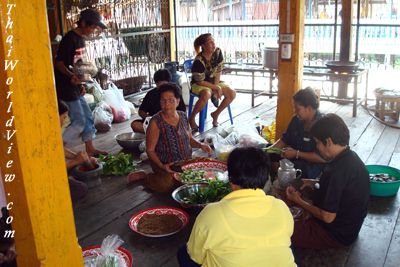
People prepare dishes and desserts (ทำของ). People
help each other (เอาแรงกัน).
|
|
| Dish preparation |
|---|
When their son is twenty years old, parents organize a Buddhist ordination ceremony. As their son becomes a monk, parents receive many merits or good deeds.
|
In a village, often two or three candidates become monks together
in order for the parents to prepare a big feast and share the costs.
|
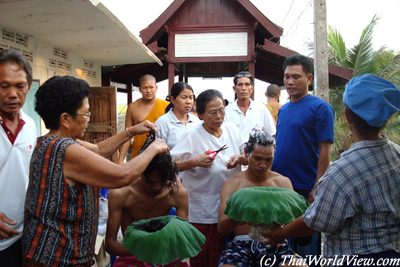
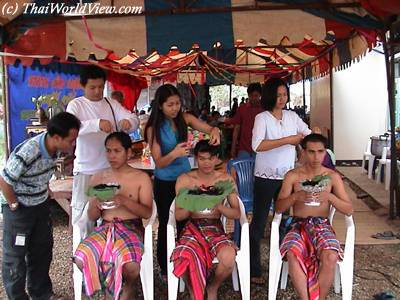
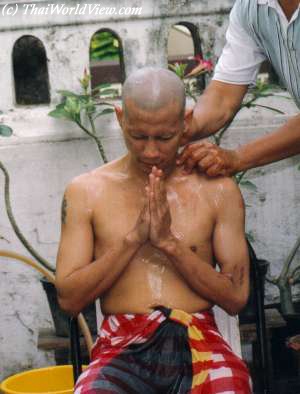
| Shave hair |
|---|
Invitations (บอกบุญ - "BOOK BUN") for ordination ceremony are sent to relatives and neighbourhood. They are coming to help for the ceremony preparation as it brings also good deed.
|
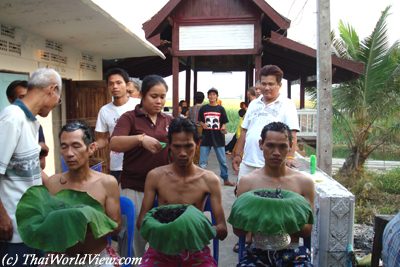
The three candidates, chest bared, sit and hold a
bowl. Then the guests and family member cut three locks of each
candidate.
|
|
| Shave hair |
|---|
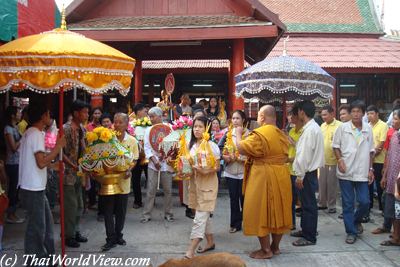
Then the first parade (แห่จากบ้านถึงวัด) happens. It goes from the ordinands' home to the Buddhist temple.
|
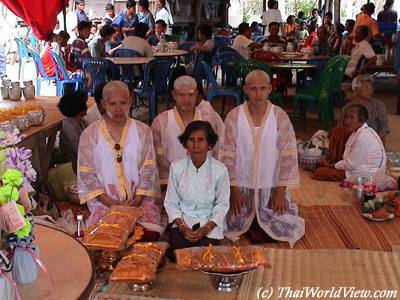
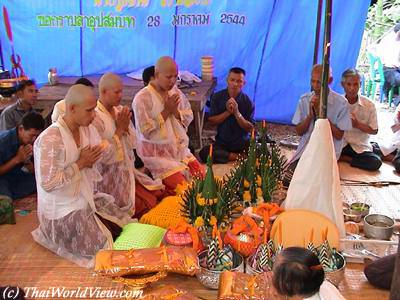
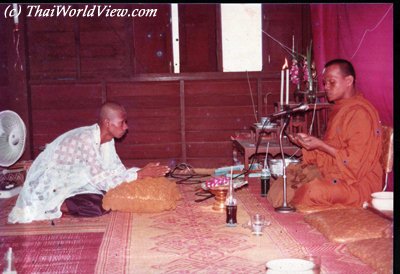
After the first parade, the ordinands, wearing their white clothes, with their family
attend a purification rite called "PHITI THAM KWAN NAK"
(พิธีทําขวัญนาค).
|
| Purification rite |
|---|
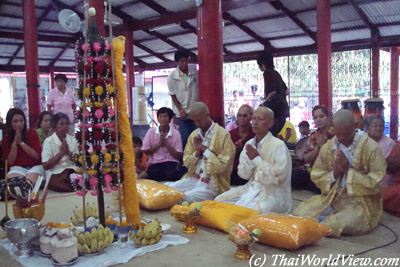
This Brahminic purification rite can be performed by a laic ("MO THAM KWAN" - หมอทําขวัญ) or a monk.
|
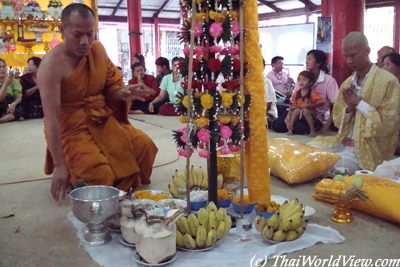
During this purification rite, a "BAI SRI" (บายศรี)
is used. This structure has a conic
shape and represents the deities' temple. it can have three, five, seven or nine stories, on
which offrands are placed.
|
|
| Purification rite |
|---|
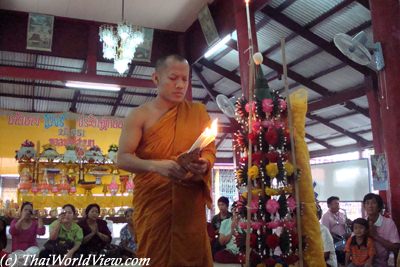
The top includes an egg called "KAI KWAN" (ไข่ขวัญ) and a candle. An orange cloth is stuck to the vertical conical structure.
|
On the floor, coconuts, bananas, rice, Thai desserts are needed for the purification
rite.
|
| Purification rite |
|---|
This rite shall wake up the spirit ("KWAN" - ขวัญ) inside the ordinand in order to purify his mind and heart to be ready for the Buddhist ordination.
|
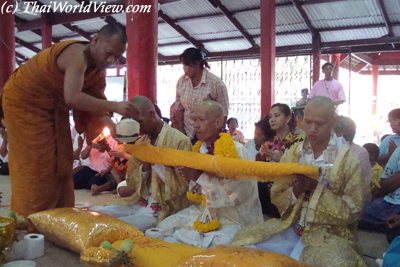
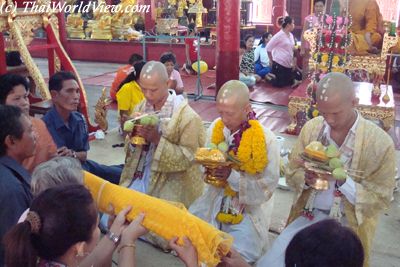
The ceremony master then gives the orange cloth to the ordinands, who will give it
to their parents.
|
|
| Purification rite |
|---|
Parents keep it in their home as an auspicious item.
|
Ordinands eat a few cakes displayed on the conic structure and receive
a few white unctions on the head.
|
| Purification rite |
|---|
The ceremony master and the ordinands circumambulate around the conic structure three times.
|
Once the purification rite is over, the parade starts again to go back to the ordinand's
home.
|
|
| Purification rite |
|---|
The "YOM" (โยมพ่อและโยมแม่) is usually the father or mother of the monk.
|
On the next day, all the family and neighbourhood parade in the village with
the ordinands.
|
| Festive parade |
|---|
|
This a festive parade where all people are dancing, drinking and have a lot of
fun.
|
|
| Festive parade |
|---|
Two days before the ordination ceremony, the young men stay home in order to avoid any material temptations that could lure them from the religious path.
|
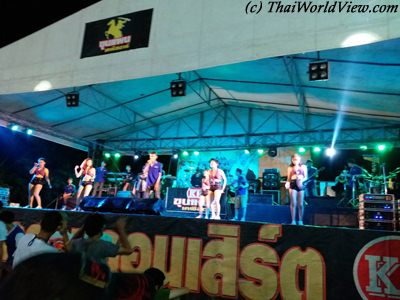
A loud music band is joining the parade to bring enjoyment for all.
|
| Festive parade |
|---|
|
The ordinands wear white clothes, symbol of purity. These clothes are
Brahminic type.
|
|
| Festive parade |
|---|
If parents have three sons and the three sons become monks, parents cannot go to hell as they shall receive so much merits from the ordinations!
|
Depending on the province and the ceremony variations, the ordinands
may walk, be carried by others, ride a horse or an elephant!
|
| Festive parade |
|---|
If the Buddhist temple (วัด) is too far from the ordinand's home, the ordinand may be transported by a car close to the temple. Then the last kilometer is done through a festive and cheerful parade.
|
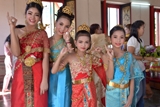
Beautifully dressed little girls are joining the parade
(แห่จากบ้านถึงวัด).
|
|
| Festive parade |
|---|
|
Those little girls are pure (บริสุทธิ์) so
they can carry sacred items to be offered to the Buddhist temple.
|
| Festive parade |
|---|
Six days before the ordination, the layman should go to the temple, should participate to all activities of the monks but is not still a monk. The head is not shaved.
|
The music band is arriving on time to bring good time for the
revellers who will join the festive parade.
|
|
| Festive parade |
|---|
|
"MA PEN" (ม้าเป็น) is a term used when a real
horse is used to carry the ordinand.
"MA TAI" (ม้าตาย) is a term used when a
carriage is used to carry the ordinand.
|
| Festive parade |
|---|
Some ordinands may be afraid of riding horse. Falling from a horse during the ordination festive parade is a bad omen. In old times, carriage supported by 10 to 20 people was used to transport the ordinand. It was called "MA MAI PAI" (ม้าไม่ไผ่) or "MA SAN" (ม้าสาร).
|
Little girls are carrying "PHAN PHUM" items
(พานพุ่ม) used to pay respect
to the King, the Queen and Buddha. It is a Royal way to wish
good health and merit (บารมี).
In Buddhist temples, those items are displayed
in front of big Buddha statues (ถวายวัด).
|
|
| Festive parade |
|---|
Only young children (เด็กบริสุทธิ์) can carry "PHAN PHUM" items. It should be young girls not yet married and not having children already (ไม่เสียพรหมจารี). Only new things and gifts shall be offered to the temple.
|
Friends of the ordinands, neighbours are joining the festive parade
and to help prepare the ceremony. Reverse help is expected.
Next time the ordinand and his family have to help for
similar ceremonies.
|
| Festive parade |
|---|
If a young man has to do his military service (โดนทหาร) for one or two years, he may never be a monk.
|
A festive atmosphere is happening. Even a ladyboy
(กะเทย) is part of the cheerful parade.
|
|
| Festive parade |
|---|
|
During wedding ceremonies, people give money and later will get back the same amount
of money when their children marry. For ordination ceremony, the same amount and a bonus
shall be given.
|
| Festive parade |
|---|
|
The last part of the parade is called "KHAO BOT"
(เข้า) or entering inside the chapel.
|
|
| Festive parade |
|---|
|
The music band is ready to bring good time for the revellers that shall
join the festive parade.
|
| Festive parade |
|---|
The "YOM UPATTHAM" (โยมอุปถัมภ์) is sponsoring the ordination and pay the expenses of the monk during his period in the order. He is believed to make great merit.
|
The young man has traditionaly requested to his parents to enter the monkhood
through the formula "KHO LA BUAT" (ขอลาบวช).
|
|
| Ordinand |
|---|
|
Similar to princes, the ordinands are supposed, same as Prince Siddharta more than
2500 years ago, to leave their palace, their family and prepare them-selves to live outside the
material world.
|
| Ordinand |
|---|
|
People dance, shout and drink. Everybody is happy. This is a festive time
in the village.
|
|
| Festive parade |
|---|
|
There are many kinds of parade around Thailand. In some areas, the ordinands ride
a horse, an elephant or simply walk.
|
| Riding horse |
|---|
|
Take part to an ordination ceremony is the opportunity for good deeds and merits
for those who help.
|
|
| Festive parade |
|---|
|
People dance, shout and drink. Everybody is happy. This is a cheerful time
in the village.
|
| Festive parade |
|---|
|
Ordinands, wearing royal clothes and cosmetics, parade through the village
being carried by horses, elephants or friends.
|
|
| Festive parade |
|---|
|
A boy is not a man until he hasn't been a monk a period of time. Traditionaly this period
was three months. Nowadays it can be only a few weeks or days. Some families still refuse to marry
their daughter if the future husband hasn't been a monk for a short period of time.
It means that he isn't ripe enough.
|
| Festive parade |
|---|
|
Everybody can join the festive parade from very young children to elderly people.
No age limitation!
|
|
| Festive parade |
|---|
|
Such parade is always a big event in the neighbourhood. Spectators enjoy the parade
and may even join the revellers!
|
| Onlookers |
|---|
|
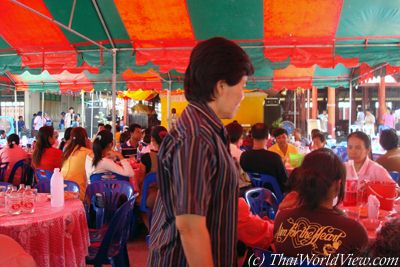
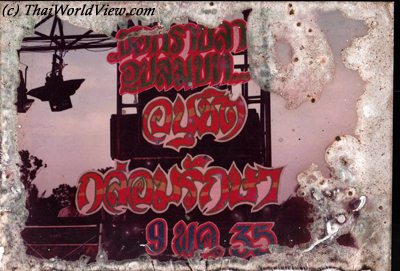
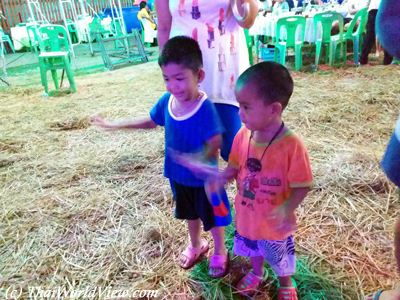
The cheerful parade ends in the ordinand's home. Revellers can rest and enjoy a
nice diner. There is music and outdoors movies from 7 p.m. to 3 a.m.
|
|
| Evening feast |
|---|
On the next day, the ordination rite takes place in the Buddhist pagoda.
|
The ordination ceremony as a monk is called "PHITI UPASOMBOT"
(พิธีอุปสมบท).
|
| Ordination ceremony |
|---|
It is a tradition for the monk candidate to turn to his relatives and scatter coins, symbolising his rejection of worldly goods.
|
In a temple, some men are monks since
decades but there are also some men who are monk only during
a short time.
|
|
| Ordination ceremony |
|---|
The candidates answer to questions asked by the priest ("UPACHANA" - อุปัชฌาย์) who officiates at the ordination ceremony.
|
Some questions are "Do you have debts ?",
"Do you have mother and father permission to become a monk ?",
"Are you a male human being ?". The last question came from Buddhist legends
when a "PHAJANAK" (พยานาค)
or snake disguises itself into a human being in order
to become a monk. Buddha discovered the trickery. The
"PHAJANAK" was not allowed to become a monk but since this time all
candidates to monkshood are called "NAK" (นาค).
|
| Ordination ceremony |
|---|
The question "Are you a male human being ?" is also linked to the fact that women cannot become monks in Thailand.
|
The new monk has learnt how to wear the monk clothes and is back in the main chapel
to listen to the abbot's last recommendations.
|
|
| Ordination ceremony |
|---|
Sometimes the candidate is so nervous that he forgets the answers he must say to the abbot. Then this one whispers the answers in order to help him.
|
The new monk receives a new monk name in Pali language. He is now part of the
monkhood.
|
| Ordination ceremony |
|---|
Foreigner can also become monk but it is then important to speak well Thai and to learn some Pali words. Anyway in some forest temples in Isan area, there are also ordinations in English.
Click to see more pictures |
|
| Home > Religions > Buddhism > Buddhist Ceremonies > Ordination |
| Page 1 | Page 2 | Page 3 |
|